
Pharmaceutical
Featured Products
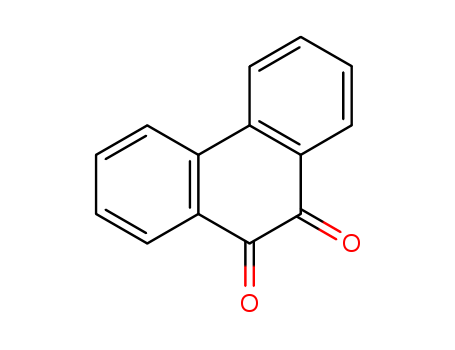
Top Quality Chinese Manufacturer supply 84-11-7 Phenanthrenequinone
- Molecular Formula: C14H8O2
- Molecular Weight: 208.216
- Appearance/Colour: burnt-orange powder
- Vapor Pressure: 2.29E-05mmHg at 25°C
- Melting Point: 209-212 °C(lit.)
- Refractive Index: 1.659
- Boiling Point: 359.999 °C at 760 mmHg
- Flash Point: 163.142 °C
- PSA: 34.14000
- Density: 1.309 g/cm3
- LogP: 2.73260
Phenanthrenequinone(Cas 84-11-7) Usage
|
Preparation |
Phenanthrenequinone is obtained by the oxidation of the hydrocarbon phenanthrene C14H10. Upon reduction with sulphur dioxide, it yields phenanthrenehydroquinone which absorbs oxygen from the air forming a black quinhydrone. Upon further oxidation the phenanthrenequinone is again formed. 9,10-Phenanthrenequinone is prepared by oxidation of phenanthrene with dihydroxy phenylselenonium benzenesulfonate in boiling dioxane-water. 9-methoxyphenanthrene is obtained when the reaction is carried out in methanol. https://www.tandfonline.com/doi/abs/10.1080/00397919708004809 |
|
Reactions |
9,10-Phenanthrenequinone (PQ) reacts with ketones under FeCl3 catalysis to furnish a variety of structurally diverse furan annulated products. While the reaction of PQ with acetone and cyclopentanone furnishes furan annulated ketals, its reaction with ethyl alkyl ketones provides 3-furaldehyde annulated products. In contrast to the reaction of PQ with cyclopentanone, its reaction with cyclohexanone furnishes a tetrahydrobenzofuran annulated secondary alcohol. The reactions of PQ with cycloheptanone and cyclooctanone take a different course to provide 7,8-dihydro-6H-cyclohepta[b]furan and 6,7,8,9-tetrahydrocycloocta[b]furan annulated products, respectively. Mechanistically, the above reactions go through aldol condensation, dehydration and cyclization to form furan-phenanthrene annulated products where in each step FeCl3 catalysis is involved. https://pubs.rsc.org/en/content/articlelanding/2012/ra/c2ra20499a |
|
Synthesis Reference(s) |
The Journal of Organic Chemistry, 52, p. 3472, 1987 DOI: 10.1021/jo00391a065 |
|
Safety Profile |
Poison by acute intraperitoneal route. Questionable carcinogen with experimental tumorigenic data by skin contact. Mutation data reported. When heated to decomposition it emits acrid smoke and irritating fumes. |
|
Purification Methods |
Crystallise the quinone from dioxane or 95% EtOH and dry it under vacuum. [Beilstein 7 IV 2565.] |
|
General Description |
Phenanthrenequinone, also known as 9,10-Phenanthraquinone, is a quinone derivative of phenanthrene formed through the oxidation of phenanthrene or its hydroxylated derivatives. It serves as a key intermediate in organic synthesis and biomimetic reactions, such as those involving flavin-mediated oxygen transfer, where it can be produced from the oxidation of 9-hydroxyphenanthrene derivatives. Its structure and reactivity make it relevant in studies of electroluminescent materials and enzymatic-like oxidation processes. |
InChI:InChI=1/C14H8O2/c15-13-11-7-3-1-5-9(11)10-6-2-4-8-12(10)14(13)16/h1-8H
84-11-7 Relevant articles
-
Patrick et al.
, p. 3413 (1976)
-
N-Aryl-9,10-phenanthreneimines as Scaffolds for Exploring Noncovalent Interactions: A Structural and Computational Study
Farrell, David,Kingston, Samuel J.,Tungulin, Dmitry,Nuzzo, Stefano,Twamley, Brendan,Platts, James A.,Baker, Robert J.
, p. 5597 - 5609 (2017)
A series of 10-[(4-halo-2,6-diisopropylp...
Synthesis, characterization, DNA binding and cleaving properties of photochemically activated phenanthrene dihydrodioxin
Tikhomirova, Anastasiia A.,Tcyrulnikov, Nikolai A.,Wilson, R. Marshall
, (2019)
Dihydrodioxin compounds are formed upon ...
Tautomerism of Representative Aromatic α-Hydroxy Carbaldehyde Anils as Studied by Spectroscopic Methods and AM1 Calculations. Synthesis of 10-Hydroxyphenanthrene-9-carbaldehyde
Alarcon, Sergio H.,Olivieri, Alejandro C.,Labadie, Guillermo R.,Cravero, Raquel M.,Gonzalez-Sierra, Manuel
, p. 4619 - 4626 (1995)
The synthesis of 10-hydroxyphenanthrene-...
-
Maruyama et al.
, p. 2777 (1977)
-
Synthetic models for catechol 1,2-dioxygenases. Interception of a metal catecholate - dioxygen adduct
Barbaro, Pierluigi,Bianchini, Claudio,Mealli, Carlo,Meli, Andrea
, p. 3181 - 3183 (1991)
-
DNA-binding and anticancer activity of binuclear gold(I) alkynyl complexes with a phenanthrenyl bridging ligand
Abdellattif, Magda H.,Alsaeedi, Mona S.,Babgi, Bandar A.,Humphrey, Mark G.,Hussien, Mostafa A.
, (2020)
3,6-Diethynyl-9,10-diethoxyphenanthrene ...
Substituted imidazole-pyrazole clubbed scaffolds: Microwave assisted synthesis and examined their in-vitro antimicrobial and antituberculosis effects
Desai, Piyush. S.,Pandya, Keyur M.,Patel, Arpan H.,Patel, Janki J.,Patel, Navin B.
, p. 574 - 582 (2021/07/25)
A series of substituted imidazole-pyrazo...
Unexpected radical mechanism in a [4+1] cycloaddition reaction
Bors, István,Purgel, Mihály,Fehér, Péter Pál,Varga, Tamás,Speier, Gábor,Korecz, László,Kaizer, József
supporting information, p. 8440 - 8444 (2021/05/25)
9,10-Phenanthrenequinone monoimines (2,7...
Rhodium-Catalyzed Aerobic Decomposition of 1,3-Diaryl-2-diazo-1,3-diketones: Mechanistic Investigation and Application to the Synthesis of Benzils
Zhu, Jia-Liang,Tsai, Yi-Ting
, p. 813 - 828 (2020/12/22)
The conversion of 1,3-diaryl-2-diazo-1,3...
Aerobic Dehydrogenation of N-Heterocycles with Grubbs Catalyst: Its Application to Assisted-Tandem Catalysis to Construct N-Containing Fused Heteroarenes
Kawauchi, Daichi,Noda, Kenta,Komatsu, Yoshiyuki,Yoshida, Kei,Ueda, Hirofumi,Tokuyama, Hidetoshi
supporting information, p. 15793 - 15798 (2020/10/12)
An aerobic dehydrogenation of nitrogen-c...
84-11-7 Process route
-
![salicylic acid-(10-hydroxy-[9]anthryl ester)](/upload/2026/9/588c04064ce2461c85f11e3ebc6f1edd_078a45b0-1755-45f1-9f2d-0c1393a3c929.png)
-
salicylic acid-(10-hydroxy-[9]anthryl ester)

-
-
7697-37-2,78989-43-2
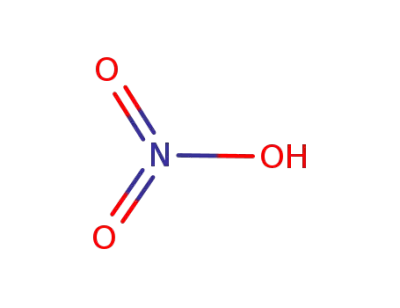
nitric acid
-
-
64-19-7,77671-22-8
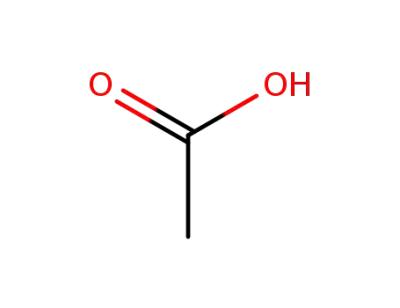
acetic acid

-
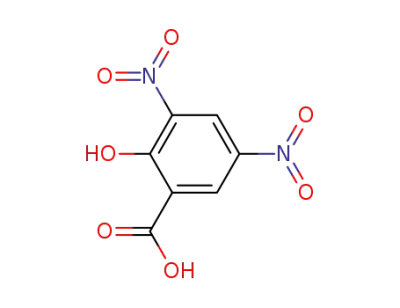
-
609-99-4
3,5-dinitrosalicylic acid
-
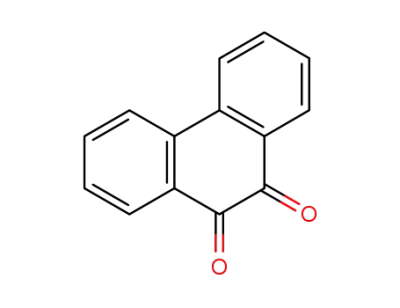
-
84-11-7
9,10-phenanthrenequinone
| Conditions | Yield |
|---|---|
|
|
-
![10-Benzoyloxy-[9]phenanthrol](/upload/2026/9/e19b2d6806774fac858a4d685adeb089_1b3dc06d-973e-4856-abe8-98ffbcf8dfd3.png)
-
39559-48-3
10-Benzoyloxy-[9]phenanthrol
-
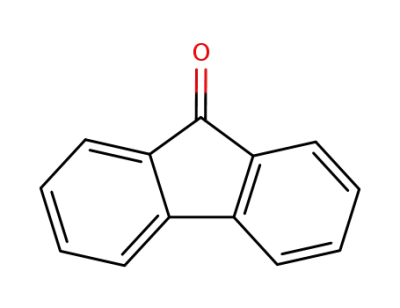
-
486-25-9,952573-42-1
9-fluorenone
-

-
100-52-7
benzaldehyde
-
-
84-11-7
9,10-phenanthrenequinone
-
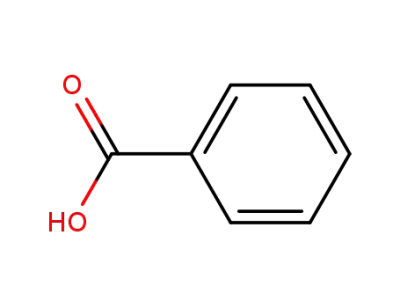
-
65-85-0,8013-63-6
benzoic acid
| Conditions | Yield |
|---|---|
|
at 200 ℃;
unter vermindertem Druck;
|
84-11-7 Upstream products
-
64-17-5

ethanol
-
67888-37-3
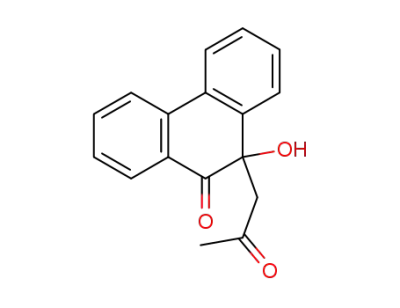
10-hydroxy-10-(2-oxopropyl)-9,10-dihydrophenanthren-9-one
-
5412-84-0
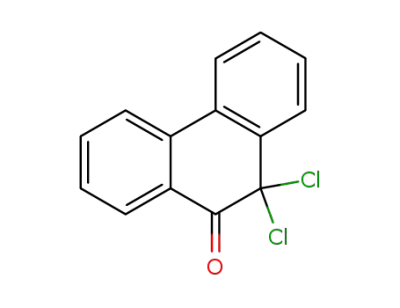
9,10-dihydro-10,10-dichlorophenanthren-9-one
-
139-02-6
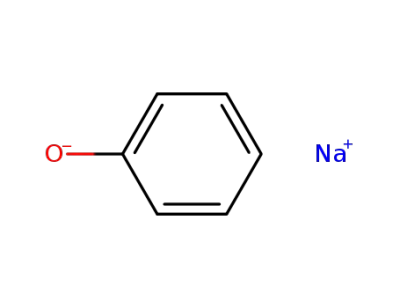
sodium phenoxide
84-11-7 Downstream products
-
100575-70-0
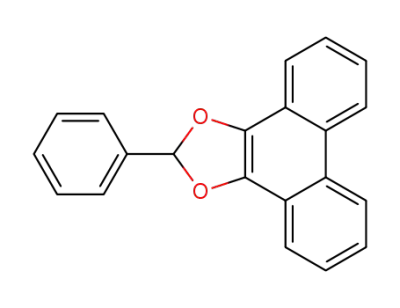
2-phenyl-phenanthro[9,10-d ][1,3]dioxole
-
111326-43-3
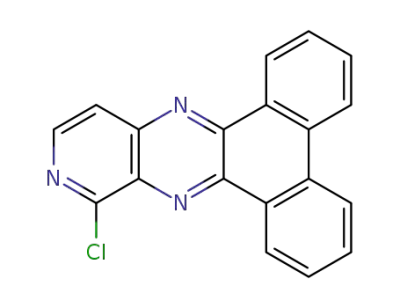
10-chloro-dibenzo[f,h ]pyrido[3,4-b ]quinoxaline
-
5768-84-3
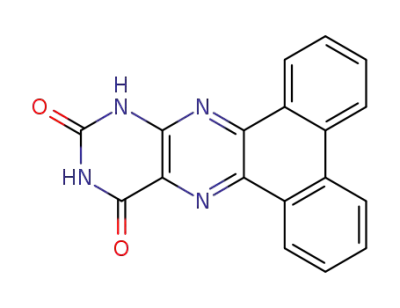
phenanthro[9,10-g]pteridine-11,13(10H,12H)-dione
-
3712-95-6
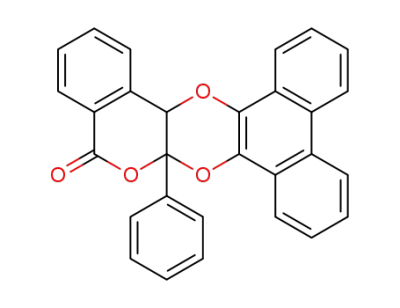
9a-phenyl-9a,15b-dihydro-phenanthro[9',10';5,6][1,4]dioxino[2,3-c ]isochromen-11-one